
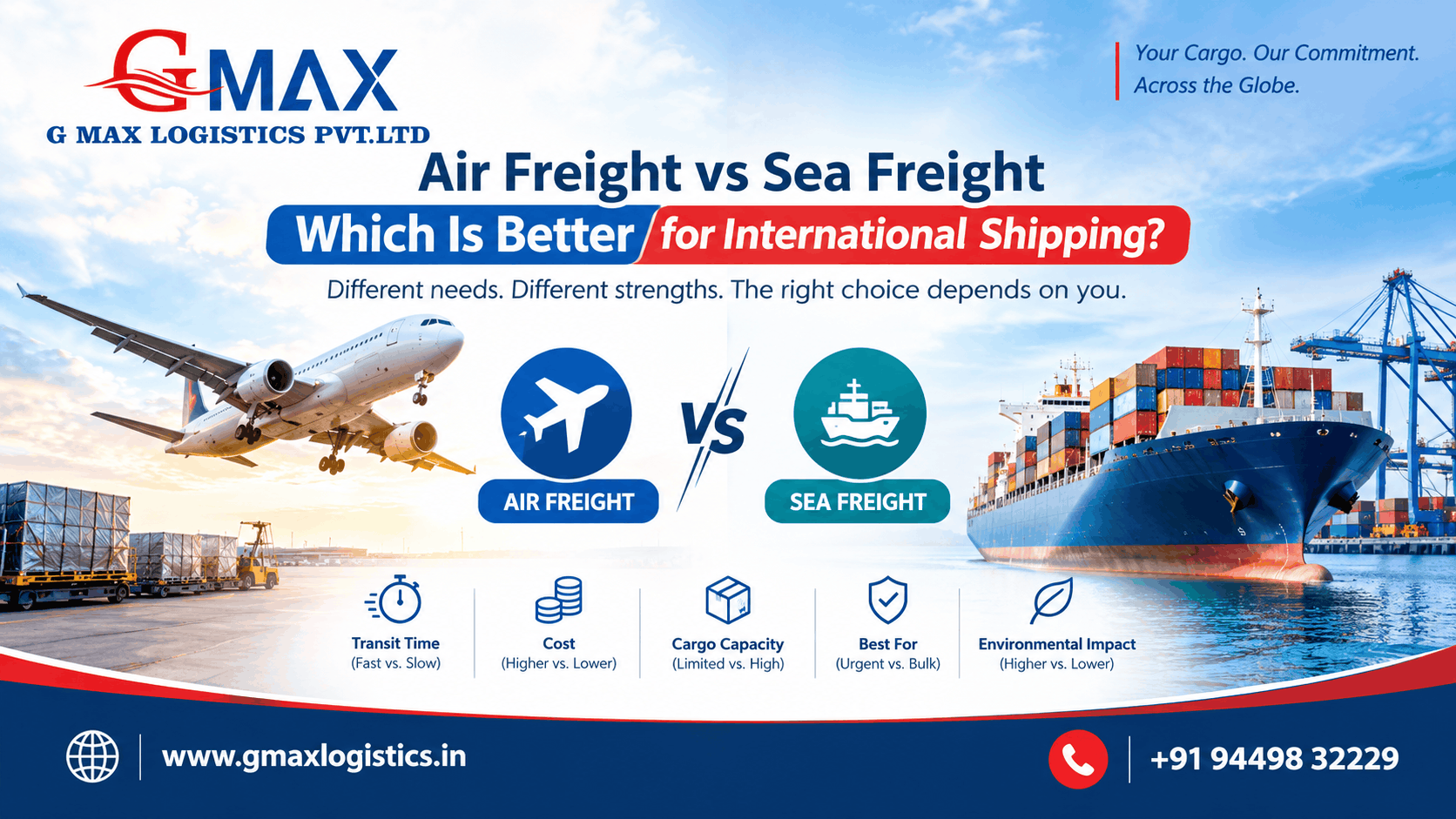
International shipping plays a crucial role in connecting businesses with suppliers, manufacturers, and customers across the world. Whether a company exports industrial machinery, electronic products, textiles, pharmaceuticals, or consumer goods, choosing the right transportation method can significantly affect delivery timelines, shipping costs, and overall supply chain efficiency.
Two of the most widely used methods are air freight and sea freight. Air freight is generally preferred for urgent, high-value, and time-sensitive shipments, while sea freight is often more economical for heavy, bulky, and large-volume cargo. However, the best option depends on several factors, including shipment size, destination, budget, cargo characteristics, and delivery deadlines.
Understanding the differences between these two methods can help businesses make smarter international shipping decisions.
1. What Is Air Freight?
Air freight involves transporting goods internationally using passenger aircraft cargo capacity or dedicated cargo aircraft. It is particularly useful when shipments need to reach their destination quickly or when delays could significantly affect business operations.
Industries such as electronics, healthcare, fashion, automotive manufacturing, and e-commerce frequently use air transportation for selected shipments.
Key advantages of air freight include:
- Faster delivery: Air transportation typically offers much shorter transit times than ocean shipping.
- Suitable for urgent cargo: Spare parts, product samples, and emergency supplies can be transported quickly.
- Global connectivity: Extensive airline networks connect major commercial centers worldwide.
- Specialized handling: Certain temperature-sensitive, valuable, and perishable goods can be transported using appropriate handling procedures.
- Inventory flexibility: Faster replenishment can help businesses reduce stock shortages and maintain production schedules.
However, air freight generally has a higher transportation cost per kilogram than sea freight. Shipment acceptance also depends on aircraft capacity, cargo dimensions, security requirements, and restrictions on certain goods.
Businesses seeking dependable transportation for urgent international shipments can explore professional air freight forwarding services to coordinate cargo bookings, documentation, customs processes, and delivery arrangements.
2. What Is Sea Freight?
Sea freight, also called ocean freight, involves transporting goods between countries using commercial cargo vessels. It is one of the most important methods of international trade because ships can carry enormous quantities of cargo over long distances.
Sea freight is commonly used for industrial machinery, furniture, textiles, construction materials, raw materials, consumer products, and other large-volume shipments.
Businesses generally choose between two major container shipping options:
- Full Container Load (FCL): A shipper books an entire container for their cargo.
- Less than Container Load (LCL): A shipper shares container space with cargo belonging to other businesses.
Depending on the shipment, sea freight may also accommodate non-containerized goods, project cargo, and oversized equipment through suitable vessels and specialized arrangements.
Key advantages of sea freight include:
- Lower transportation costs: It is often more economical for heavy or bulky shipments.
- High cargo capacity: Ships can transport large quantities in a single voyage.
- Flexible cargo options: Containerized, palletized, and certain specialized cargo can be accommodated.
- Suitable for planned shipments: Businesses can move substantial inventory when delivery deadlines allow longer transit times.
The main disadvantages are longer transit times, port handling requirements, potential congestion, and exposure to schedule changes caused by weather or operational disruptions.
3. Air Freight vs Sea Freight: Key Differences
The following comparison highlights the main considerations when selecting a shipping method.
| Factor | Air Freight | Sea Freight |
| Transit time | Generally faster | Generally slower |
| Transportation cost | Usually higher | Usually lower per unit for large shipments |
| Cargo capacity | Limited by aircraft size and payload | Very high carrying capacity |
| Best suited for | Urgent, valuable, lightweight cargo | Heavy, bulky, and high-volume cargo |
| Shipment size | Often practical for smaller consignments | Often economical for larger consignments |
| Scheduling | Depends on flight availability and cargo capacity | Depends on vessel schedules and port operations |
| Environmental impact | Generally higher emissions per tonne-kilometre | Generally lower emissions per tonne-kilometre than air |
| Handling requirements | Aviation security and aircraft cargo restrictions | Port handling, container management, and maritime requirements |
Actual transit times, prices, and emissions vary according to the route, shipment characteristics, carrier, and logistics arrangements. Air freight is not automatically the best option for every small shipment, and sea freight is not always the cheapest once all associated costs are included.
4. Which Shipping Method Is More Cost-Effective?
Cost is one of the most important factors in international shipping. Air freight rates are commonly calculated using chargeable weight, which considers both actual weight and volumetric weight. Consequently, large but lightweight packages may attract higher charges than their physical weight suggests.
Sea freight costs depend on factors such as container size, cargo volume, weight, route, port charges, and whether the shipment uses FCL or LCL services.
However, comparing only the quoted transportation rate can be misleading. Businesses should also consider customs clearance, insurance, packaging, terminal handling, inland transportation, warehousing, and possible storage or demurrage charges.
For example, a manufacturer exporting several tonnes of furniture may find sea freight more economical. Conversely, a company sending urgent electronic components to prevent a production shutdown may find the additional cost of air freight worthwhile.
The best decision comes from comparing the total landed cost and the financial consequences of delivery delays.
Also Read: Air Freight Logistics: Why Speed Still Wins in Modern Supply Chains
5. How Delivery Time Influences Your Decision
Delivery deadlines can determine which transportation method is appropriate.
Air freight is generally preferable when goods must arrive quickly, products have a limited shelf life, or production depends on the immediate availability of imported components.
Sea freight is more suitable when shipments can be planned in advance and inventory levels can accommodate longer transportation periods. Businesses importing seasonal merchandise or large quantities of raw materials often benefit from advance planning and consolidated ocean shipments.
It is also important to consider the complete journey. Airport or seaport handling, customs clearance, inspections, and final-mile delivery can all influence the actual time required to receive a shipment.
6. Which Option Is Better for Your Business?
There is no universal winner between air and sea freight. The appropriate option depends on your business priorities.
Choose air freight when speed, urgent replenishment, or specialized handling is essential. Choose sea freight when moving substantial cargo volumes economically is the main objective and delivery schedules allow sufficient time.
Some businesses benefit from a combined approach. For example, they may transport regular inventory by sea while using air freight for urgent stock replenishment or unexpected demand. This strategy can balance transportation costs with supply chain responsiveness.
When evaluating logistics ocean freight solutions, businesses should consider route availability, cargo compatibility, container requirements, documentation, customs procedures, and coordination with inland transportation.
Working with an experienced logistics partner can simplify these decisions by helping coordinate carriers, shipping documentation, cargo handling, and delivery planning.
Conclusion
Air freight and sea freight both play essential roles in international trade. Air freight offers speed and is particularly valuable for urgent, high-value, and time-sensitive shipments. Sea freight provides substantial cargo capacity and is often the more economical choice for heavy, bulky, and large-volume goods.
Before selecting a shipping method, businesses should evaluate their cargo type, budget, delivery deadlines, shipment dimensions, and complete transportation costs. In some cases, combining both methods can provide an effective balance between speed and affordability.
With careful planning and reliable logistics coordination, businesses can improve delivery performance, control transportation expenses, and build a more efficient international supply chain. The right shipping strategy is ultimately the one that supports your business requirements while delivering goods safely, reliably, and cost-effectively.