
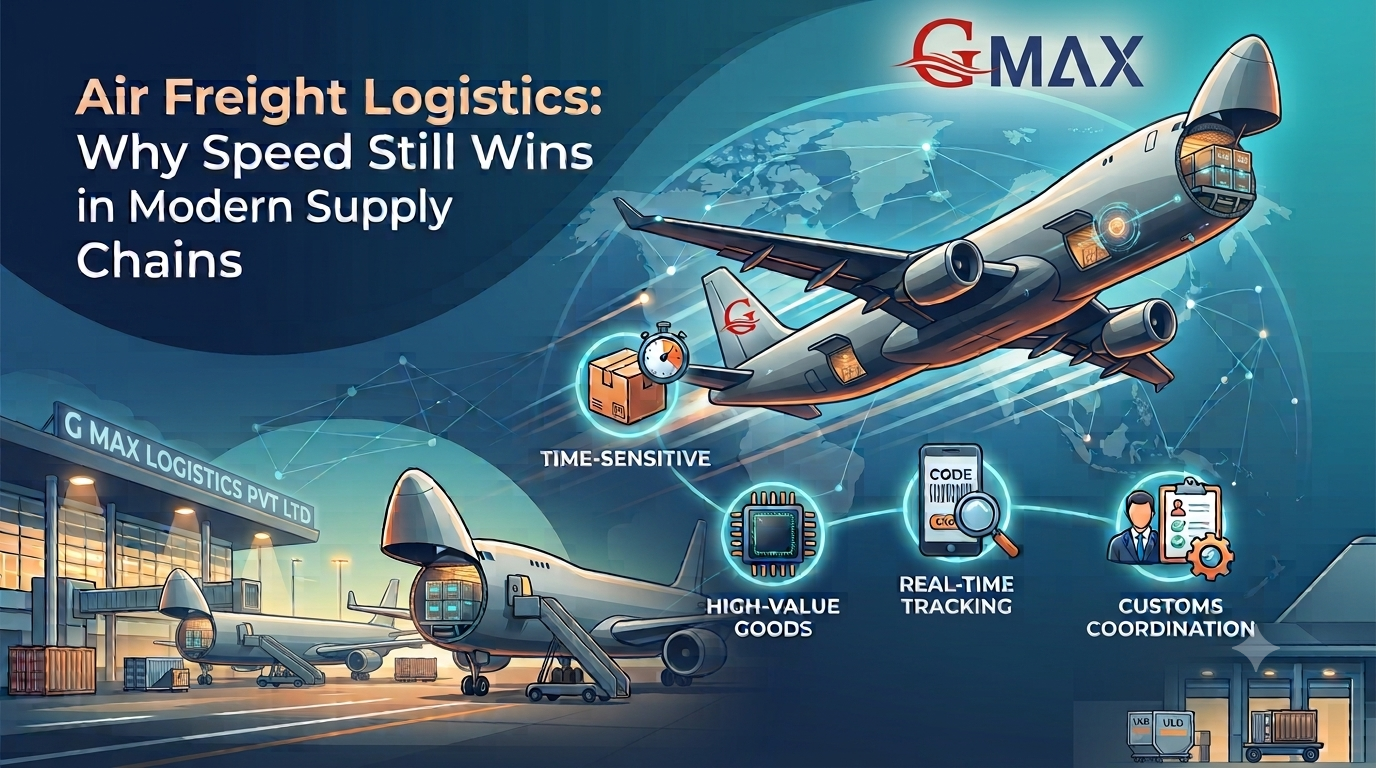
If you’ve ever waited on a shipment that absolutely, positively had to arrive yesterday, you already understand why air freight logistics exists. It’s not the cheapest way to move goods. It’s not always the simplest either, once you factor in customs paperwork, airport handling, and capacity crunches during peak season. But when time is the one thing you can’t buy back, air freight is the tool that gets the job done.
At Gmax Logistics, we deal with this reality every single day. Businesses come to us not because they love paying a premium, but because a delay would cost them far more than the freight bill ever could. So let’s talk about what air freight logistics actually involves, why it matters, and how to use it without burning through your budget.
What Exactly Is Air Freight Logistics?
In plain terms, air freight logistics is the process of planning, coordinating, and executing the movement of goods by aircraft — from the moment a shipment leaves the seller’s warehouse to the moment it lands in the buyer’s hands. It’s not just “put the box on a plane.” There’s a whole chain of moving parts behind it:
- Booking cargo space with airlines or charter operators
- Packing and labeling goods to meet aviation safety standards
- Preparing export and import documentation
- Coordinating ground transport to and from airports
- Managing customs clearance on both ends
- Tracking the shipment in real time until delivery
Miss any one of these steps, and even the fastest flight in the world won’t save you from a delay sitting in a customs warehouse.
Why Businesses Choose Air Freight Over Sea or Road
Nobody chooses air freight by accident. It’s almost always a deliberate trade-off between cost and speed. Here’s when it tends to make the most sense:
Time-sensitive shipments. Pharmaceuticals, perishable food, fashion inventory tied to a seasonal launch — these can’t sit in a shipping container for six weeks.
High-value, low-volume goods. Electronics components, jewelry, and precision machinery parts are often small enough and valuable enough that the cost-per-kilogram of flying them is worth it.
Unpredictable demand spikes. When a product suddenly takes off (no pun intended) and a business needs stock urgently, air freight bridges the gap until ocean shipments catch up.
Reducing inventory holding costs. Faster transit means less money tied up in warehoused stock, which actually offsets some of the higher freight cost.
Sea freight will always be cheaper per unit. But cheaper doesn’t help much if your shelves are empty for two months.
The Real Cost Factors Behind Air Freight
People often assume air freight pricing is just “expensive,” full stop. In reality, it’s calculated against several variables, and understanding them helps you negotiate smarter:
- Chargeable weight — airlines price based on whichever is higher: actual weight or volumetric (dimensional) weight
- Fuel surcharges — these fluctuate with global oil prices and can shift quarter to quarter
- Route and airport congestion — flying into a major hub versus a smaller regional airport changes handling costs
- Seasonality — rates climb during peak shipping periods like the months before major holidays
- Type of cargo — hazardous materials, oversized cargo, or temperature-controlled goods all carry additional handling fees
A good freight partner doesn’t just quote you a number — they explain where that number comes from, and where there’s room to optimize.
Common Challenges in Air Freight Logistics
It would be misleading to make air freight sound effortless. There are real friction points businesses run into:
- Capacity shortages. Available cargo space tightens dramatically during festive seasons or global disruptions, pushing prices up and delaying bookings.
- Customs delays. Incomplete documentation is one of the most common (and most avoidable) reasons shipments get held up.
- Limited cargo dimensions. Aircraft have stricter size and weight restrictions than ships or trucks, so oversized cargo sometimes simply isn’t an option.
- Cost sensitivity. For low-margin products, air freight can eat into profitability if it’s used as a default rather than a strategic choice.
None of these are reasons to avoid air freight — they’re reasons to plan around it properly, ideally with a logistics partner who has already seen these problems play out a hundred times before.
How to Make Air Freight Work for Your Business
A few practical habits separate businesses that use air freight efficiently from those who treat it as a last-minute panic button:
- Plan ahead whenever possible. Even a 48-hour lead time can mean better rates and guaranteed space.
- Consolidate shipments. Combining smaller shipments into one larger booking often reduces per-unit cost.
- Get documentation right the first time. Commercial invoices, packing lists, and certificates of origin should be airtight before the cargo even reaches the airport.
- Work with a freight forwarder who understands both ends. Origin and destination handling are equally important — a smooth pickup means nothing if customs clearance on arrival is a mess.
- Use a mix of air and sea where it makes sense. Some businesses split shipments: urgent stock by air, bulk replenishment by sea. It’s not all-or-nothing.
This is actually where most of the value of using international freight forwarding services comes in. A forwarder isn’t just booking you a seat on a cargo plane — they’re managing the entire chain of custody, paperwork, and coordination so you don’t have to chase a dozen vendors yourself.
Where Air Freight Logistics Is Headed
The industry isn’t standing still. A few trends worth watching:
- Greater use of real-time tracking technology, giving shippers visibility down to the individual parcel level
- Sustainability pressure, pushing airlines and forwarders to explore more fuel-efficient routing and carbon offset programs
- Digital booking platforms, which are slowly replacing the old back-and-forth email quoting process
- Tighter integration between air and last-mile delivery, so goods move faster from tarmac to doorstep
Businesses that stay plugged into these shifts tend to get more reliable service and better pricing over time, simply because they’re working with forwarders who are evolving alongside the industry.
Final Thoughts
Air freight logistics isn’t about choosing the fanciest or fastest option every time — it’s about knowing exactly when speed matters more than cost, and having a partner who can execute that decision without surprises. Done right, it protects your customer relationships, keeps your supply chain resilient, and turns “we need this urgently” into a problem that’s already solved.
At Gmax Logistics, that’s exactly the role we play for businesses across industries — handling the complexity of air freight logistics so our clients can focus on running their business, not chasing shipments.
If your supply chain has a deadline that can’t move, it might be time to talk to a team that treats air freight as a strategy, not a scramble.